Chronic kidney disease is common, affecting 1 in 10 adults. It is associated with high morbidity and mortality and has no cure. CAPTIVATE aims to find the best treatment, or combination of treatments, to slow chronic kidney disease progression so fewer people develop kidney failure and suffer complications of impaired kidney function.
What is an adaptive platform trial?
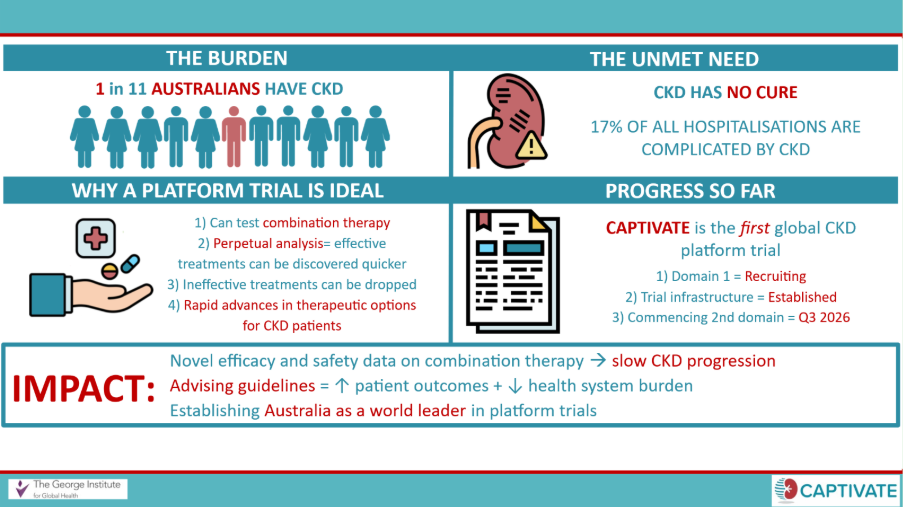
An adaptive platform trial uses a perpetual trial design to test a range of different treatments within a common trial setup. New treatments are added to the platform as they become available, and existing treatments are stopped once the data indicate it is or is not working. This way, results are generated much more quickly than a standard clinical trial in a cost-effective and resource-efficient manner. The trial design also allows us to investigate whether treatments work best when used alone or in combination with each other.
Why are we doing an adaptive platform trial in kidney disease?
A few new therapies are available that slow kidney disease progression and some new therapies are on the horizon and show promise. Some of the new treatments are only available to a subset of people with chronic kidney disease but early data suggests they could benefit a wider group of people and this needs to be tested further. We anticipate that treatments will need to be used in combination with each other to gain the maximum benefit for people with chronic kidney disease.
CAPTIVATE uses an adaptive trial design so that high quality evidence on multiple new treatments and combinations of agents can be developed in a shorter timeframe. The ‘perpetual’ analysis of study results means that effective study treatments will be found quicker, and ineffective treatments will be stopped quicker. The end goal of CAPTIVATE is to continuously improve the treatment options available to people living with kidney disease, until we can prevent the disease progression altogether.